Borosilicate Temperature Range: Real Safe Working Limits for Lab Glassware
Ask ten people for the borosilicate temperature range and you will get ten different answers: minus 50 to 500 degrees Celsius, minus 40 to 300 degrees Celsius, or a number lifted straight from a cookware catalogue. All of them are partly right, and none of them tells you what you actually need to know before you clamp a flask onto a heating mantle at four in the afternoon.
The honest answer is that borosilicate 3.3 has an extremely wide temperature window, but the range you can safely use is narrower than the glass itself. It depends on how the vessel was made, how thick the wall is, how quickly you change the temperature, and what you ask the glass to do while it is hot. What follows is the set of numbers we work with every day, at the bench and in our own production shop.
Why Borosilicate Glass Covers Such a Wide Temperature Range
Borosilicate 3.3 is not "strong glass" in the everyday sense. Its advantage is chemical. Roughly 81 percent of the material is silicon dioxide, about 13 percent is boron trioxide, and the small remainder is sodium and potassium oxides. The boron atoms stiffen the network and reduce how much the structure expands when it is heated.
The practical consequence is a coefficient of linear thermal expansion of about 3.3 x 10⁻⁶ per Kelvin. Soda-lime glass, the material used for windows and most drinking glasses, expands at roughly three times that rate. That single difference explains almost everything about the borosilicate temperature range: less expansion means less internal stress when one part of a vessel is hot while another part is cold.
If you want the material side in more detail, our note on borosilicate glass composition explains how SiO2, B2O3 and the 3.3 designation fit together.
The Reference Points That Define the Range
When a manufacturer quotes a borosilicate temperature range, they are usually referring to one of four fixed points measured on the glass itself. These are material properties rather than usage recommendations, and mixing them up is the most common source of confusion.
| Reference point | Typical value | What it tells you |
|---|---|---|
| Strain point | 510 °C | Internal stress stops relaxing; upper limit for permanent service |
| Annealing point | 565 °C | Stress relieves within minutes; used during manufacture |
| Softening point | 821 °C | Glass deforms under its own weight; no structural use above this |
| Working point | 1252 °C | Viscosity is low enough to shape and form the glass |
| Continuous use | about 250 °C | Long heating periods with no visible change |
| Short excursion | about 500 °C | Brief exposure only, with no mechanical load |
| Thermal shock | about 165 °C difference | Largest safe gradient across the wall of a part |
| Lower limit | about -50 °C | Remains usable; warm it slowly afterwards |
The gap between the highest of these points and the temperature you would ever use in a laboratory is large. That gap is not wasted headroom. It is the margin that keeps a flask intact when your heating is uneven, when a joint is under load, or when someone walks past with a cold draught.
Thermal Shock Is the Limit You Meet First
In practice, almost no laboratory vessel fails because it was held above its softening point. They fail because of a sudden change across the wall. A borosilicate 3.3 part can normally survive a difference of around 165 degrees Celsius between its hottest and coolest surfaces. Push past that and the surface layers try to expand or contract faster than the bulk of the glass can follow, and a crack starts, usually at a joint, a scratch or a sharp corner.
This is why the borosilicate temperature range is best read as two numbers rather than one: the maximum temperature, and the maximum rate of change. A condenser that handles hot solvent vapour while cold water runs through its jacket lives on this boundary every day, which is why jacketed parts are built with a wall thickness and a geometry that spread the stress.
Rule of thumb: the glass rarely cares how hot it gets. It cares how fast, and how unevenly.
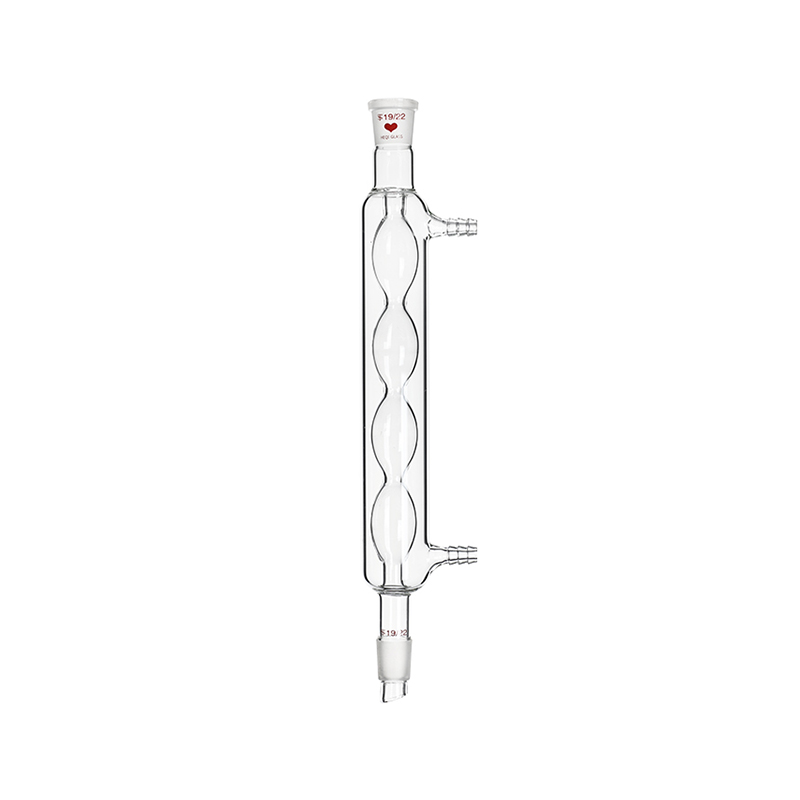 Class A Borosilicate Allihn Condenser for Laboratory Vapor CondensationA Class A borosilicate Allihn condenser with standard joints and a large heat-transfer area, available in several lengths and joint sizes for vapor condensation.View Product →
Safe Working Limits in Everyday Laboratory Practice
Manufacturers usually quote a continuous working temperature of about 250 degrees Celsius for borosilicate 3.3, with short excursions up to roughly 500 degrees Celsius. Those two figures describe very different situations, and the difference matters more than the numbers themselves.
Continuous heating
Heating mantles, oil baths and hotplates hold glassware in the 100 to 250 degree band for hours at a time. In that range the material is comfortable, but the equipment around it is not always so forgiving. Contact with a bare hotplate surface, a mantle that has worn unevenly, or a flame that touches one side of a flask creates exactly the localised difference the glass dislikes. Use a bath, a well-fitting mantle or a heating block, and bring the temperature up gradually rather than in one jump.
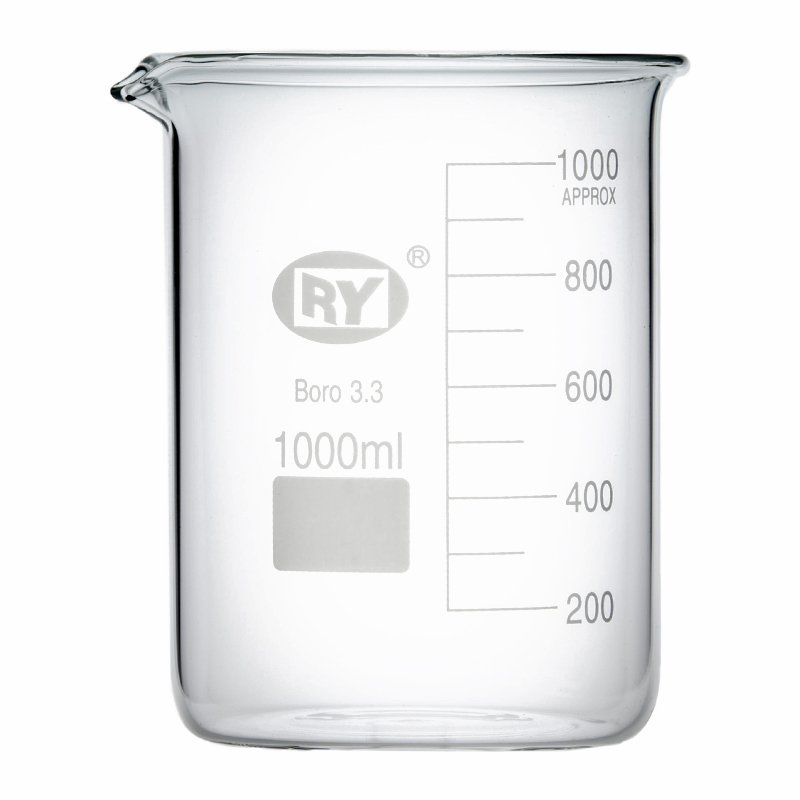
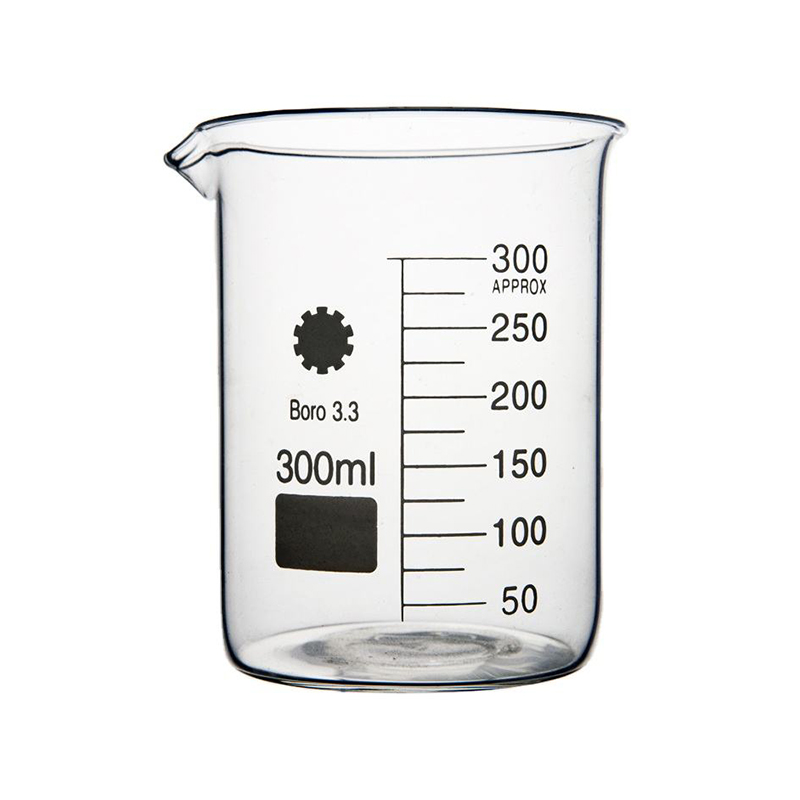
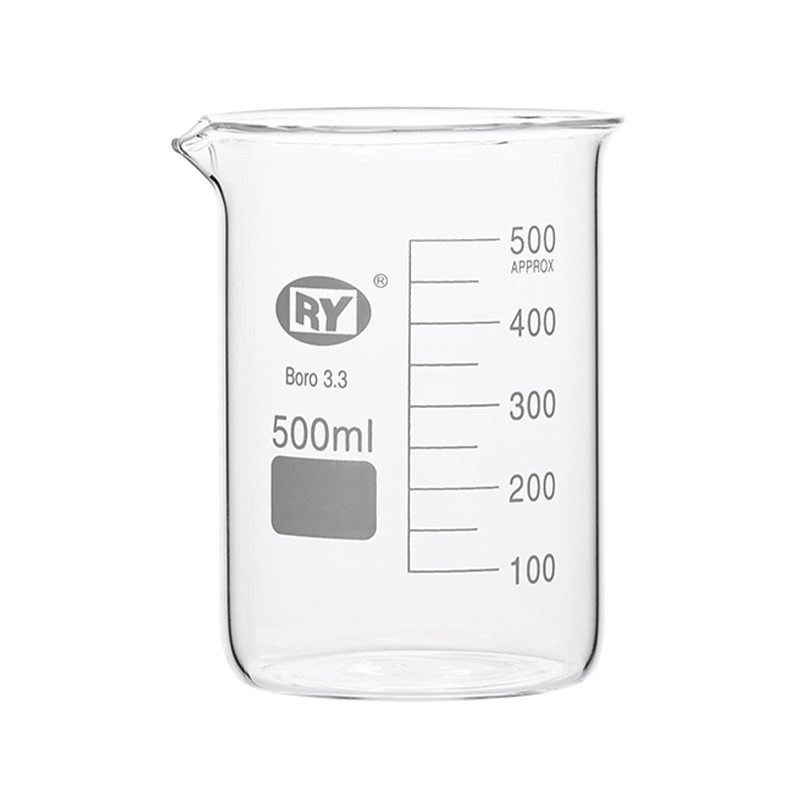 Thick-Walled Low Form Borosilicate Glass BeakerA thick-walled, low-form borosilicate beaker for routine mixing, sample storage and simple reactions, with capacities from 5 ml to 10000 ml.View Product →
Cooling and cryogenic work
The lower end of the range is often underestimated. Borosilicate 3.3 remains usable down to about minus 50 degrees Celsius, and some grades go lower. Cold is generally gentler than heat because the glass contracts slowly, but the return trip is the dangerous part. A flask taken straight from a dry ice bath to a warm bench, or rinsed under warm water while still cold, is being asked to span the whole thermal shock limit in a few seconds. Let it come back to room temperature on its own.
Vacuum and pressure
Temperature and pressure should be considered together. A vessel under vacuum carries an additional load on its walls, and that load reduces the temperature difference it can tolerate. A round shape handles this far better than a flat one, which is why round-bottom flasks, not Erlenmeyer flasks, are the default choice for vacuum distillation.
What Narrows Your Real Working Range
The figures above describe ideal glass. Real glassware carries a few things that reduce the margin:
- Wall thickness. Thin walls follow temperature changes quickly, thick walls hold more stress. Both are safe when the change is gradual.
- Ground joints and stopcocks. A joint concentrates stress, and a PTFE stopcock expands differently from glass, which can seize a cold tap.
- Scratches and star cracks. A visible defect can lower shock resistance by a wide margin. Retire the piece.
- Metal clamps and supports. Metal conducts heat away from the contact point and creates a cold spot on a hot vessel.
- Geometry. Flat bottoms, sharp bends and long unsupported spans all concentrate stress.
None of these rules is exotic. They are the reason a well-run laboratory treats glassware as a consumable with a service life rather than as permanent furniture.
Matching Glassware to the Temperature You Need
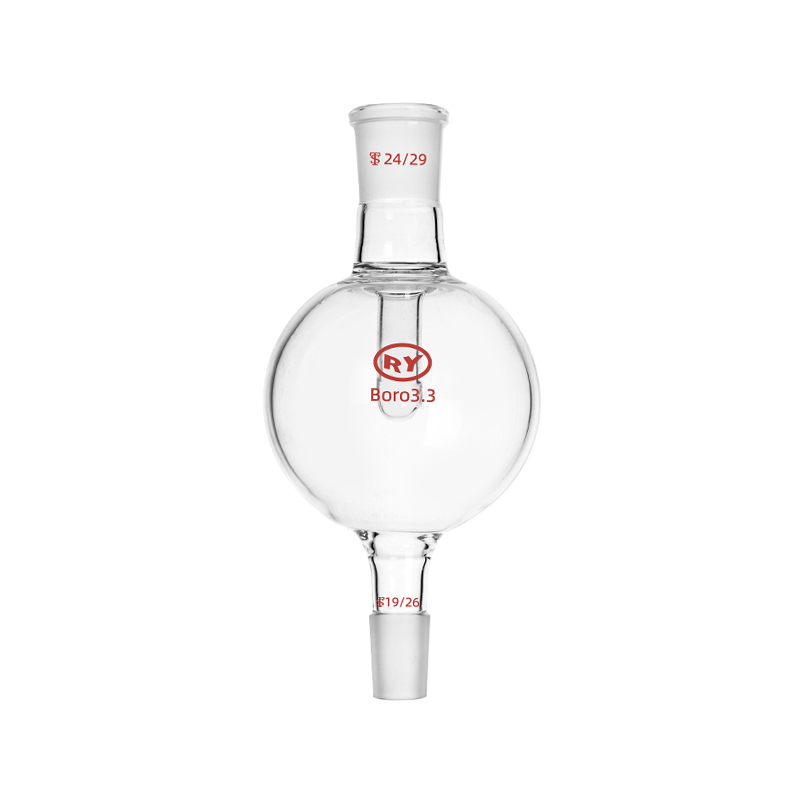
Because the safe range depends so much on design, the most reliable approach is to choose glassware that was built for the job. Our own 3.3 borosilicate glassware is produced with wall thickness and joint geometry selected for the operation each piece is meant to perform: distillation and reflux, filtration under vacuum, storage, and small-scale reaction work.
For work that moves beyond a flask on a mantle, the calculation changes again. A jacketed reactor spreads heat over a much larger surface than a mantle does, which is precisely why it can hold a tighter temperature band for longer. A benchtop reactor is the usual starting point when a process needs controlled heating and cooling rather than a single set point.
 Custom Lab Benchtop Reactor with Integrated Heating and StirringA compact benchtop reactor integrating heating, stirring and temperature control, suited to small-scale synthesis, reaction optimization and customizable laboratory setups.View Product →
Whatever you choose, the principle is the same. Treat the published borosilicate temperature range as the outer boundary of the material, then subtract for the shape, the load and the way you heat it. What remains is a working range you can trust.
Frequently Asked Questions
What is the maximum temperature for borosilicate glass?
For continuous laboratory use, plan on about 250 degrees Celsius. Short exposures up to roughly 500 degrees Celsius are possible with no mechanical load, and the material's own softening point is far higher, near 821 degrees Celsius. The lower figure exists because safety margin, not material failure, sets the practical limit.
Can borosilicate glass go in a freezer?
Yes. It stays usable down to about minus 50 degrees Celsius, and many grades are rated lower. The risk is the return trip, so warm the vessel slowly to room temperature before washing or heating it.
Why did my flask crack at only 150 degrees Celsius?
Almost always because of a local temperature difference rather than the absolute temperature. A cold draught, a metal clamp, a wet spot on a hotplate or a sudden addition of cold liquid can each create a gradient larger than the glass can absorb.
How much temperature difference can borosilicate take?
Around 165 degrees Celsius between the hottest and coldest points of a part is a reasonable working figure for borosilicate 3.3. Soda-lime glass manages much less, which is why kitchen glassware and laboratory glassware behave so differently.
Does a thicker wall make glassware more heat resistant?
Not in the way most people expect. Thicker walls resist mechanical impact better but hold more thermal stress, so they need slower temperature changes. Thin-walled glass follows a change in temperature more easily.
Does the temperature range change under vacuum?
Yes. Vacuum adds a mechanical load to the walls, so the temperature difference a vessel can safely tolerate is reduced. Round forms handle this combination far better than flat or angular ones.